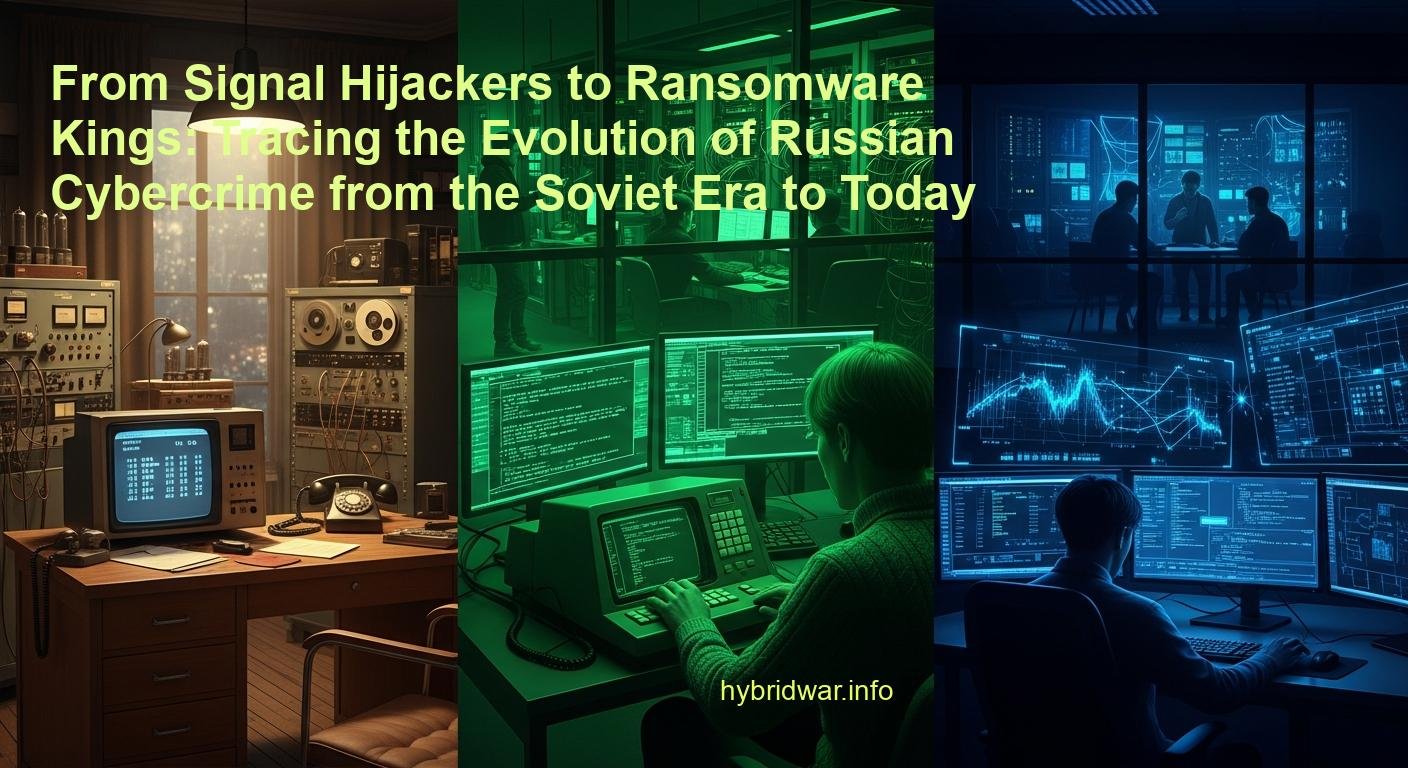
Introduction: The Intersection of Politics, Technology, and Crime in Russia’s Cyber History
Russia’s complicated history in the realm of cybercrime is a product of intersecting political ambitions, rapid technological advancements, and socio-economic turbulence. From the tightly controlled information ecosystem of the Soviet Union to today’s sophisticated networks of cybercriminal organizations, there has been a continuous evolution in the motivation and execution of cyber-attacks. Political control, economic challenges, and the democratization of digital technology have all played pivotal roles in shaping the methods deployed by these groups. As we embark on this historical journey, it is important to recognize how state policies, emerging internet infrastructures, and the entrepreneurial spirit of rogue hackers contributed collectively to Russia’s prominent role in the global cybercrime landscape.
The Soviet Era: Information Control and the Precursor to Cyber Misuse
During the Soviet era, the regime’s insistence on information control created an environment where surveillance was not only a state priority but also an underlying precursor to what we now see as cyber misuse. The KGB and other security apparatuses maintained strict oversight on communications, monitoring, and intelligence gathering. While traditional cybercrime was not a concept in the digital age, the practices of information manipulation and covert operations laid the groundwork for later illicit activities online. This period instilled a culture of secrecy, and the techniques honed in these operations would later be adapted and misused by hackers and cybercriminals in the post-Soviet era.
Early Signatures of Cyber Disobedience: Broadcast Signal Intrusions of the 1970s and 1980s
The 1970s and 1980s witnessed early examples of technological subversion when hackers began to experiment with broadcast signal intrusions. Although rudimentary compared to modern cyber-attacks, these early acts were symbolic of a growing dissatisfaction with state-controlled media and the overbearing censorship of the era. Notably, these acts of disobedience represented both a technical challenge to government narratives and an early indication of the innovative ways in which technology could be repurposed for dissent. The ingenuity behind these intrusions foreshadowed the later, more sophisticated attacks that would exploit vulnerabilities in digital infrastructures.
Post-Soviet Transition: Economic Challenges and the Rise of Individual Hackers
The collapse of the Soviet Union in 1991 ushered in an era of uncertainty and rapid change. The ensuing economic instability and political disarray created fertile ground for the emergence of individual hackers. Many techno-savvy individuals found themselves with newfound opportunities to explore the then-nascent world of computer networks. With limited regulation and a rapidly expanding internet, these early hackers began to experiment with exploiting vulnerabilities for personal and political gain. Their activities ranged from hacking into financial institutions to unauthorized data breaches. This period was marked by both a spirit of rebellion and an entrepreneurial drive, as these hackers navigated a digital world that was expanding far faster than established legal and security frameworks could adapt.
Notable Early Hackers: Vladimir Levin and the 1990s Cybercrime Spotlight
Among the pioneers of cybercrime, Vladimir Levin stands out as a seminal figure whose actions in the 1990s cast a long shadow over the evolving domain of digital misdemeanors. Levin’s high-profile intrusions, including his infamous attempt to steal millions from major financial institutions, underscored the potential of cybercrime to disrupt traditional banking systems. His exploits captured global attention and helped to propel cybercrime into a mainstream concern, prompting law enforcement agencies around the world to begin focusing on digital offenses. Levin’s actions illustrate the early potential for individual hackers to impact global systems and laid the conceptual framework for later organized cybercrime networks.
Organized Cybercrime in the 2000s: Formation of Russian Cybercriminal Networks
The 2000s marked a decisive turnaround from the era of individual hackers to the emergence of sophisticated criminal networks operating on an industrial scale. During this time, Russian cybercriminal groups began to organize with a level of precision and business-like structure that had never been seen before. These organizations quickly evolved into full-blown criminal enterprises, exploiting the vulnerabilities in global financial and technological systems. One notable milestone during this period was the emergence of malware like the Lurk Trojan, which, according to research, was involved in significant financial thefts, including stealing over $45 million from targeted banks ([Kaspersky Lab Assists in Russia’s Largest Cybercriminal Arrest: The Hackers Who Stole $45 Million](https://www.kaspersky.com/about/press-releases/kaspersky-lab-assists-in-russia-s-largest-cybercriminal-arrest-the-hackers-who-stole-45-million?utm_source=openai)). This period set the stage for the scale and organization seen in later years.
Case Study: The GameOver ZeuS Botnet and its Global Impact
The transformation from dispersed individual acts to organized, international operations is best exemplified by the case of the GameOver ZeuS botnet. Although our research highlights other significant malware like the Lurk Trojan and notable cases involving groups like Evil Corp, the evolution of these tools into formidable botnets marked a pivotal change in the cybercrime scene. The GameOver ZeuS botnet, leveraging the infamous Zeus malware, was sophisticated enough to facilitate large-scale financial crimes across the globe. This case study underscores how cybercriminal organizations have honed their tactics over time, integrating advanced malware, coordinated strategies, and even aligning with state interests. Such networks not only exploited financial systems but also demonstrated the potential for widespread disruption, influencing subsequent regulatory and security responses internationally ([Russian malware hackers charged in evil corp $100 million bank scheme](https://www.cnbc.com/2019/12/05/russian-malware-hackers-charged-in-massive-100-million-bank-scheme.html?utm_source=openai)).
Today’s Landscape: Russian-Speaking Hackers and Ransomware Domination
In recent years, Russian-speaking hackers have come to dominate the cybercrime landscape, particularly through the use of ransomware. Groups like LockBit, which emerged around 2019, represent a new wave of ransomware networks that operate with a refined business model. They recruit affiliates from all over the globe to implement their attacks in a structured manner, often demanding large ransoms in exchange for unlocking critical data. The modern strategy involves not only encrypting files but also exfiltrating sensitive data as additional leverage. The transformation from crude signal hijackers to organized ransomware entities illustrates a trajectory of increasing sophistication and profitability. With the geopolitical context, such as the post-2022 Ukraine conflict, further fueling the environment for hacktivism (e.g., actions by groups like Killnet, as detailed in [Killnet](https://en.wikipedia.org/wiki/Killnet?utm_source=openai)), today’s cybercrime is as much about political expression as it is about financial gain.
Content Gaps and Future Trends: What Lies Ahead in Russian Cybercrime
Despite the wealth of historical data, significant questions remain about how Russian cybercrime will evolve in the future. Content gaps persist in our understanding of how emerging technologies like artificial intelligence, blockchain, and quantum computing might be weaponized by these groups. Current trends suggest that we may see an even greater integration of state-sponsored activities and freelance cybercriminals, blurring the lines between political motivations and profit-driven schemes. Researchers and cybersecurity experts are increasingly focusing on these gaps, seeking to anticipate the next wave of vulnerabilities and the potential restructuring of cybercrime conglomerates. As cyber defenses evolve, so too will the tactics of these criminal networks, making active research and global cooperation critical for the detection and prevention of future attacks.
Conclusion: The Continuing Evolution and Global Cybersecurity Challenges
The history of Russian cybercrime is a testament to the dynamic interplay between technological innovation and criminal ingenuity. From the early days of state surveillance in the Soviet Union to the highly organized ransomware networks of today, each era has contributed to shaping the current cyber threat landscape. While the evolution of hacking techniques and the sophistication of cybercriminal organizations continue to pose significant challenges to global cybersecurity, understanding this historical context is essential for developing effective countermeasures. The ongoing evolution of these threats—and their often ambiguous ties to state interests—ensures that both policymakers and cybersecurity professionals remain vigilant in their efforts to secure our digital future.
Leave a Reply